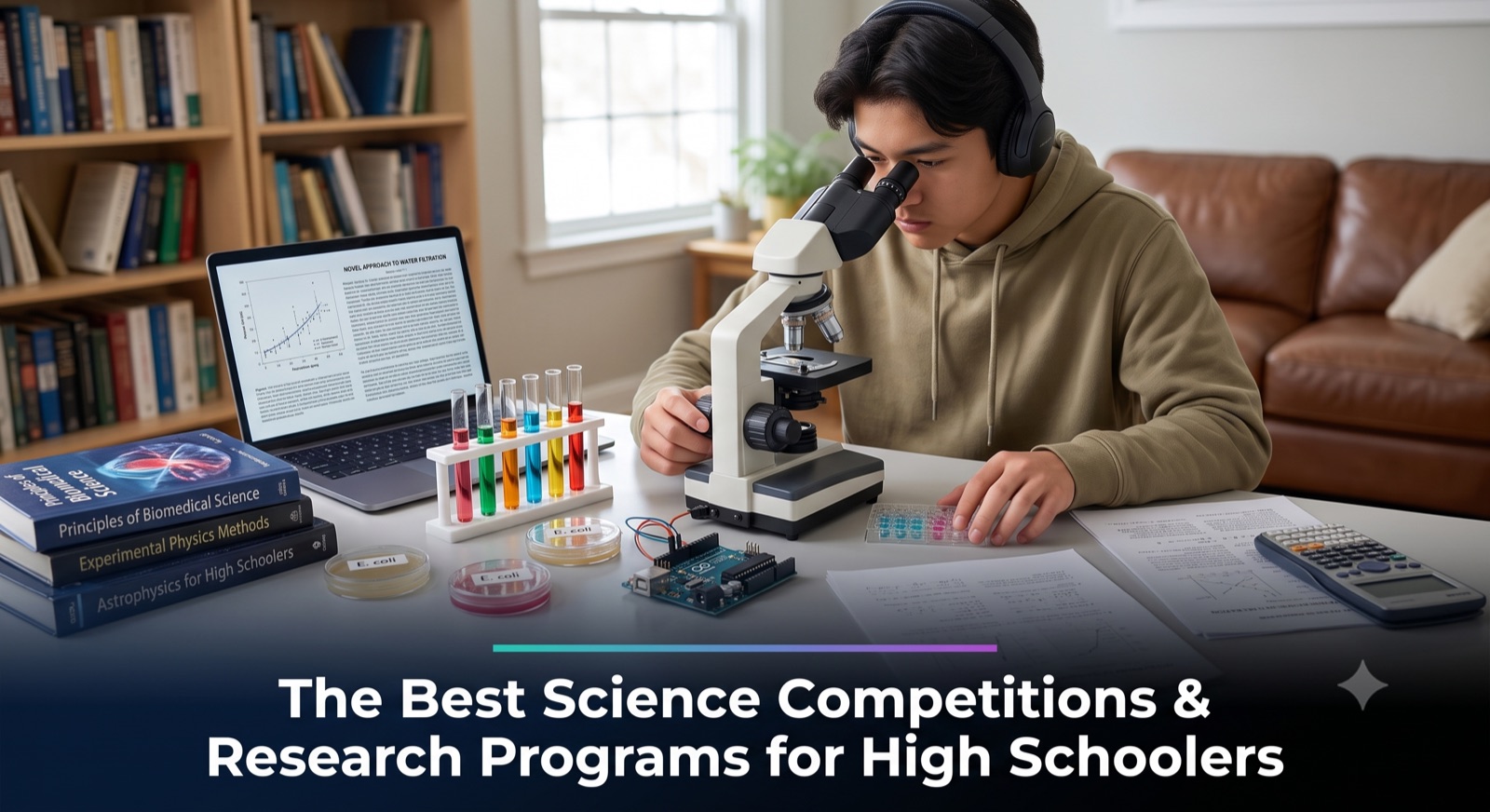
The 9 Best Science Competitions & Research Programs for High Schoolers (2026)
On this page
- 1. Science Olympiad
- 2. USA Biology Olympiad (USABO)
- 3. US National Chemistry Olympiad (USNCO)
- 4. USA Physics Olympiad (F=ma)
- 5. Regeneron Science Talent Search (STS)
- 6. Regeneron International Science and Engineering Fair (ISEF)
- The premier research programs
- 7. Research Science Institute (RSI)
- 8. Summer Science Program (SSP)
- 9. Simons Summer Research Program
- How to build toward any of this
- Frequently asked questions
The strongest high school science profiles almost always follow one of two lanes: a subject olympiad that proves depth in a single field, or an independent research program that proves a student can do real, original work. Competitions test what you know; research programs test what you can discover. You do not need both, and you certainly do not need all of them — you need one lane pursued seriously, and most students are naturally stronger in one.
Here are the 9 best science competitions and research programs for high schoolers, what each is, who qualifies, and how to approach them. For our full verified list with current details, see our science competitions page.
1. Science Olympiad
Type: Team competition · Best for: An accessible entry point and discovering which sciences you enjoy · Eligibility: School-based teams
Science Olympiad is the most accessible entry point, and it is a team event. Schools field teams that compete across roughly two dozen events spanning biology, chemistry, physics, earth science, and engineering. Some events are written tests; others are hands-on builds.
Because it runs at the school and regional level before advancing to state and national tournaments, Science Olympiad is far easier to join than the individual olympiads. It is an excellent way for younger high schoolers to discover which sciences they enjoy before committing to a specialized track.
2. USA Biology Olympiad (USABO)
Type: Subject olympiad (individual exam) · Best for: Students who enjoy dense reading and memory-heavy material
The individual olympiads are national exams that narrow a large pool down to a small national team, generally through multiple rounds. They are meaningfully selective — advancing past the first round already marks a student as strong, and reaching the national training camp or team is a genuinely rare distinction.
USA Biology Olympiad (USABO) starts with an open online round, then a semifinal exam, and ultimately selects a small group for a residential finals program from which the international team is chosen. It suits students who enjoy dense reading and memory-heavy material across molecular biology, physiology, ecology, and more.
3. US National Chemistry Olympiad (USNCO)
Type: Subject olympiad (individual exam) · Best for: Command of general and organic chemistry plus lab reasoning
US National Chemistry Olympiad (USNCO) runs through local sections before a national exam and a study camp that selects the international team. It rewards command of general and organic chemistry plus lab reasoning.
4. USA Physics Olympiad (F=ma)
Type: Subject olympiad (individual exam) · Best for: Students strong in mechanics and physics
USA Physics Olympiad begins with the F=ma exam, a mechanics-focused qualifier, before advancing students to the USAPhO exam and eventually a training camp. F=ma is the gateway most students aim for first; qualifying beyond it is a strong signal on its own.
Who these olympiads suit: a student with a clear favorite science and the discipline to self-study well past the AP level. Strong AP coursework in the subject is the natural foundation — see our AP courses overview.
5. Regeneron Science Talent Search (STS)
Type: National research competition · Best for: Seniors with an original research project · Eligibility: US-based
Regeneron Science Talent Search (STS) is a national research competition for high school seniors. Students submit an original research project and are judged on the science and on their broader potential; scholars and finalists are named each year. It is one of the most prestigious recognitions available to a young scientist and is US-based.
6. Regeneron International Science and Engineering Fair (ISEF)
Type: Research fair · Best for: Students advancing through regional and state fairs · Eligibility: International
Regeneron International Science and Engineering Fair (ISEF) is the world's largest pre-college science fair. Students typically qualify by winning affiliated regional and state fairs, then compete internationally across many categories. As the name implies, ISEF draws participants from around the world, not only the United States.
Both fairs reward the same thing: a real research project with a clear question, sound method, and defensible results — usually the product of a mentored program or a self-driven investigation carried out over many months.
The premier research programs
These summer programs are where many competitive research projects begin. They are highly selective, and each has a distinct flavor.
| Program | Focus | Who it suits |
|---|---|---|
| Research Science Institute (RSI) | Mentored STEM research at a university, with a written and oral project | Advanced students ready for graduate-level lab work |
| Summer Science Program (SSP) | Immersive, cohort-based research in a specific field such as astrophysics, biochemistry, or genomics | Students who want a structured, guided research experience |
| Simons Summer Research Program | Independent research in a university lab under a faculty mentor | Students seeking a genuine, hands-on lab placement |
7. Research Science Institute (RSI)
Type: Mentored summer research program · Best for: Advanced students ready for graduate-level lab work
Research Science Institute (RSI) is among the most selective STEM summer programs anywhere. Admitted students spend the summer on a mentored research project and present their work formally. It suits students who are already comfortable operating at a near-collegiate level.
8. Summer Science Program (SSP)
Type: Cohort-based summer research program · Best for: Students who want a structured, guided research experience
Summer Science Program (SSP) places students in a defined field and works them through a shared, hands-on research problem as a cohort. It is a strong fit for students who want rigorous research with more structure and guidance than a solo lab placement provides.
9. Simons Summer Research Program
Type: University-lab summer research program · Best for: Students seeking a genuine, hands-on lab placement
Simons Summer Research Program matches students with a university faculty mentor for an independent project in that lab. It rewards students who can work with real graduate researchers and take ownership of a piece of a larger effort.
How to build toward any of this
Start earlier and narrower than you think. Pick a lane, then a subject, then go deep.
- Ninth and tenth grade: join Science Olympiad or a science club, take the foundational AP science courses, and read widely to find the field you actually enjoy.
- Tenth and eleventh grade: commit to one olympiad and study past its first round, or begin a research project — through a program, a local university, or independent work you can eventually enter into a fair.
- Eleventh and twelfth grade: aim for a national round or a summer research program, and prepare the STS or ISEF entry if research is your lane.
Strong grades in the relevant AP sciences and solid standardized test scores form the academic base admissions officers expect to see beneath any of these accomplishments. IvyStrides' AP courses and SAT prep help build that foundation; a free consultation is a good place to map out which lane fits your student.
Frequently asked questions
Do I need both a competition and a research program? No. Pick the lane that fits you and go deep. One national-level olympiad result or one serious research project is far more compelling than shallow participation in several.
How selective are these? In general terms, the individual olympiads narrow large national pools to small teams over multiple rounds, and programs like RSI, SSP, and Simons admit only a small fraction of applicants. Advancing past an early round or being admitted at all is already a meaningful distinction.
Which programs are US-only versus international? The Regeneron Science Talent Search is US-based, while Regeneron ISEF draws competitors worldwide. The subject olympiads select US national teams that then compete internationally.
When should a student start? Ideally in ninth or tenth grade — early enough to explore with Science Olympiad and AP coursework, then commit to a single lane by junior year.
Where can I see the full, verified list? Our science competitions section keeps current details, and our broader academic competitions page covers other subjects.

Rajesh is a technology leader, entrepreneur, and angel investor with 28+ years in Business & Technology Leadership and Product & Solution Engineering. He is passionate about education, mentoring, and driving digital transformation.