
How to Reuse Essays Across Applications: The Complete 2026 Playbook for a Top Score
On this page
- The Short Answer: What You Can and Cannot Reuse (Read This First)
- The Three-Tier Reuse Framework: Copy, Adapt, or Rewrite
- Tier 1: Copy (Submit Identically)
- Tier 2: Adapt (Same Bones, Targeted Edits)
- Tier 3: Rewrite (Fresh Draft Every Time)
- When Reusing an Essay Becomes a Real Risk
- Can You Submit the Same Essay to Multiple Colleges? The Common App Mechanics Explained
- Build a Reuse-Ready Personal Statement Before You Apply Anywhere
- Reusing Essays for Scholarships: What Changes and What Stays the Same
- Can Admissions Officers Tell When an Essay Was Written by AI?
- A Step-by-Step Reuse Checklist for Your 2026 Application Season
- FAQ
- Can you reuse college application essays across different schools?
- Can I change my Common App essay after I have already submitted to one school?
- Is it okay to copy and paste my essay directly into the Common App?
- Should I reuse supplemental essays for different colleges?
- Can I reuse my Common App essay when reapplying to a school in a later cycle?
- Do colleges share essays with each other to catch reuse?
- Your Next Move
Yes, you can reuse essays across applications, but the right approach depends on the essay type. Your Common App personal statement is submitted identically to every Common App member school by design, so one 650-word draft covers your entire Common App list. Supplemental essays need school-specific tailoring before reuse, even when two prompts look nearly identical. Scholarship essays are reusable when the prompt theme and audience closely match your existing draft.
The word limits and prompt count cited above come from the Common App. The harder question is which essays fall into which reuse tier, and how to catch the one mistake that quietly sinks reused drafts every cycle. The next section starts there.
The Short Answer: What You Can and Cannot Reuse (Read This First)
Three categories, three rules.
Your Common App personal statement (650 words, one of seven prompts for the 2025-26 cycle per the Common App) is designed for reuse. Every Common App member school receives the same essay you save in your account. You don't rewrite it per school. That's the whole point of the platform.
Your supplemental essays are the opposite. A Why School essay for Duke isn't a Why School essay for Northwestern. A community essay for Michigan isn't a community essay for Rice. The prompts sometimes rhyme; the answers rarely do. Reuse here means adapting a core draft with institution-specific tailoring, not copying.
Your scholarship essays live in the middle. If a scholarship asks about leadership and your personal statement is about leading a robotics team through a rebuild, the theme travels. If the scholarship asks about a career goal and your essay is about grief, it doesn't.
The framework we use with students has three tiers: Copy, Adapt, Rewrite. Before you write anything else, understand what is the college application essay actually doing in an admissions read. That context sharpens every reuse call you're about to make.
The Three-Tier Reuse Framework: Copy, Adapt, or Rewrite
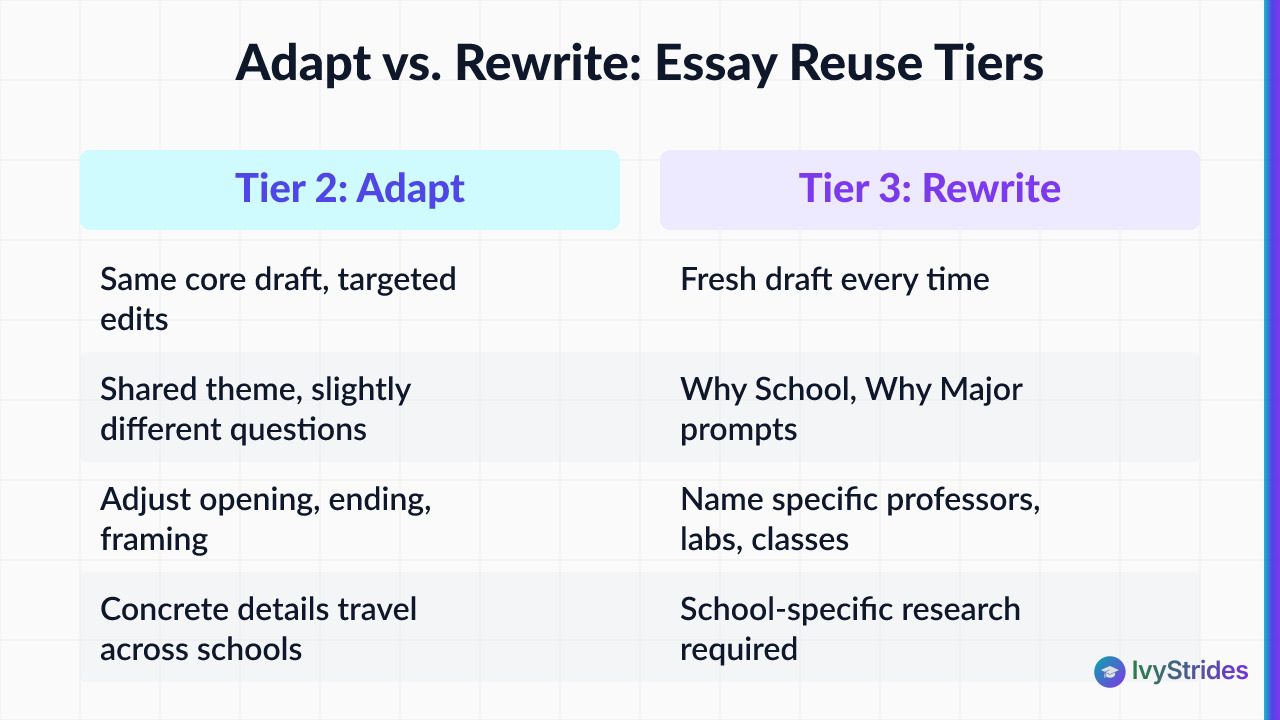
Here's the tool. Apply it to every essay on your list.
Tier 1: Copy (Submit Identically)
Tier 1 essays are written once and submitted unchanged. The Common App personal statement is the clearest example: one 650-word draft, seven prompt options, delivered identically to every Common App school. The Coalition Application personal statement accepts a very similar essay format, and QuestBridge finalists reuse their personal statement across QuestBridge match schools by design.
Nothing changes between submissions. No school name to swap. No prompt to re-read. You wrote it once, and the platform does the rest.
Tier 2: Adapt (Same Bones, Targeted Edits)
Most of your reuse work happens here. Two supplemental prompts share a theme but ask slightly different questions. A community essay at one school runs 250 words; at another, 400. An activity essay at School A asks what you learned; at School B, why it mattered.
You're not writing from scratch. You're lifting your best paragraph, resetting the opening, and adjusting the ending to answer the exact question in front of you. If two schools both ask "describe a challenge you overcame," the same core anecdote works, but the framing shifts to hit the specific verb each prompt uses.
Concrete detail travels well. A student who scored a 5 on AP Biology can reference that same intellectual moment across three or four schools' academic-interest essays, because the detail is real and portable. Learn to show don't tell in college essays and your Tier 2 adaptations will hold up under the swap.
Tier 3: Rewrite (Fresh Draft Every Time)
Tier 3 is non-negotiable. Why School essays, Why Major essays, and school-specific identity or program prompts must be written for each institution. If your essay names a specific professor, a specific research lab, a specific dorm tradition, or a specific class number, it belongs to that school and only that school.
Across hundreds of supplemental essay drafts in our coaching, Why School essays submitted without school-specific research are the category most frequently flagged by admissions readers as generic. There's no shortcut. You research the school, name three concrete things you cannot get anywhere else, and connect them to who you are.
The prompt-match test is simple. Read the prompt out loud. Read your reused essay out loud. If your essay doesn't answer the exact question asked at the destination school, it isn't adaptable. It's a rewrite.
For the mechanics of building an anchor draft that adapts well across your list, see how to structure your personal statement.
When Reusing an Essay Becomes a Real Risk
The fear is real, and it should be. In our coaching, the single most common reuse mistake we catch in essay reviews is the institution-name error: a student submits a Why Duke essay to Vanderbilt with the word "Duke" still sitting in paragraph three. It happens every cycle. It happens to strong writers. It happens because reuse feels like it saves time until it doesn't.
Second failure mode: prompt mismatch. Two prompts look alike. They're not. One asks about a challenge you overcame, the other about a challenge you're still facing. A reused essay that answers the wrong verb tense reads as inattentive, and admissions officers who read hundreds of essays per cycle notice.
Third: test-optional context raises the stakes. At schools where you choose not to submit SAT or ACT scores, your essays carry more weight in the review, so a carelessly reused supplemental can cost you more than it would at a score-required school. Test-optional policies vary by school and year, so verify each school's current policy on their admissions page and cross-check against the FairTest tracker. A strong SAT or ACT score reduces pressure on every other application component, including essays, which is why students who invest in both score prep and essay coaching tend to apply with more confidence. If you're still weighing whether does the SAT matter for college admission for your list, that decision changes how much your reused essays have to carry.
One caveat worth stating clearly: admissions outcomes depend on the full application, not essays alone. A carelessly reused essay hurts. It rarely, on its own, decides.
Can You Submit the Same Essay to Multiple Colleges? The Common App Mechanics Explained
Yes, and the platform is built for it. But the mechanics have one rule most students miss.
Your Common App personal statement lives in a single field in your account. The 650-word limit applies to every submission, per the Common App. When you click Submit for a specific school, that school receives a snapshot of your essay as it exists at that moment. That snapshot is locked. You cannot edit the essay for a school that has already received it.
Here's the part most students miss: you can still edit the essay for schools you haven't yet submitted to. So if you submit to School A on November 1st, then revise the essay on November 5th, School B (submitted November 10th) receives the revised version. School A still has the November 1st draft. Your submission order matters. If you're refining the essay through the fall, submit to your safeties first and your reaches last, so the reach schools see the most polished version.
The 2025-26 Common App cycle kept the seven personal statement prompts largely stable from the prior year, but always verify against the current Common App site before submitting.
One technical warning on formatting. Copying and pasting from Google Docs or Word directly into the Common App text field can carry smart quotes, curly punctuation, and special characters that render as symbols or question marks in the submitted essay. Paste into a plain-text editor first (TextEdit on Mac, Notepad on PC), then paste from there into Common App. Scroll through the full essay after pasting to check that every character rendered correctly. This takes about 90 seconds and prevents a real problem.
If you want a second set of eyes on the anchor draft before you start submitting, a common app essay tutor can pressure-test the personal statement your entire list will inherit.
Build a Reuse-Ready Personal Statement Before You Apply Anywhere
Reusing essays is only one part of a broader essay strategy; understanding how to structure your personal statement from the start makes every reuse decision easier.
In our coaching, the personal statements that travel best across applications share one structural trait: they're built around a specific moment or decision, not a broad theme. "Leadership" doesn't travel. The moment you told your debate captain you were quitting, then didn't, does. Specificity is what makes an essay portable, because a specific anecdote can be extracted, compressed, or expanded into a supplemental essay without losing its shape.
A strong personal statement often contains two or three anecdotes woven around a central insight. Each is a potential supplemental essay. The robotics-team story becomes a 250-word activity essay. The moment with your grandmother becomes a 400-word community essay. The failed experiment becomes an intellectual-curiosity essay. You wrote them all once, inside the personal statement, and now you're extracting and reshaping them for specific prompts. This is Tier 2 done right.
Start from the Common App seven prompts for 2025-26 and pick the one that fits the specific moment you already know you want to write about. Not the reverse. Do not pick a prompt and then hunt for a story to match it.
If your personal statement is strong enough to anchor your entire application, it becomes the asset you adapt everywhere; our 1:1 help for common app essay is built around creating exactly that kind of foundational draft. Once the personal statement is stable, our essay review service audits the supplementals that grow out of it.
Reusing Essays for Scholarships: What Changes and What Stays the Same
Scholarship reuse follows the same three-tier logic with two twists: audience and word limit.
Scholarship committees are often not admissions officers. They may include community members, alumni, donors, or working professionals who read for very different signals than a Yale reader does. Academic register and "intellectual vitality" language that plays well in an admissions read can fall flat in a scholarship read. When adapting an admissions essay for a scholarship, strip the college-application register and write in a voice that sounds like you telling a specific person a specific story.
Prompt alignment matters more than you'd expect. A scholarship essay asking about leadership or community impact often shares enough thematic overlap with Common App prompts 2, 5, or 7 to allow Tier 2 adaptation. A scholarship asking about a specific career field, financial need, or a values-based question tied to the sponsoring organization is Tier 3. Rewrite.
Word limit mismatches are the most common scholarship reuse failure. Cutting a 650-word personal statement to 300 words isn't trimming. It's a structural rewrite. You cannot just delete adjectives and shorten sentences and expect the essay to hold. You pick the single strongest beat, cut the other two, and reshape the opening and closing around what remains. A 300-word essay isn't a compressed 650. It's a different essay.
If the scholarship connects to a specific academic area (STEM scholarships, humanities awards), a concrete score point like a 5 on a relevant AP exam anchors the essay in something real. Students in our ap courses online often surface AP moments as scholarship-essay material because the detail is verifiable and specific.
Can Admissions Officers Tell When an Essay Was Written by AI?
Often, yes. And this intersects with the reuse question in one direct way.
Admissions readers look for voice consistency across your application. Your personal statement, your supplemental short answers, your teacher recommendations, your activity descriptions, and your Common App additional information section all pass through the same reader. When one component reads in a dramatically different register than the others, that's a flag. It might be AI. It might be a parent's rewrite. It might be a paid editor who overreached. Whatever the source, inconsistency is what triggers scrutiny.
AI-generated prose has a recognizable shape: abstract nouns, symmetrical sentences, safe transitions, and a striking absence of specific personal detail. It rarely names a real person, a real place, or a real small moment. That's the opposite of what makes a reusable personal statement strong. Specificity is the reuse asset. Generic prose isn't.
There's a real distinction here worth naming. Using AI to brainstorm topics, to check grammar, or to pressure-test a draft is different from submitting AI-generated prose as your own writing. The first is a tool. The second is a risk that can undercut an otherwise strong application.
The safest reuse strategy is also the safest anti-AI strategy: build the personal statement around a specific real moment in your life, in your actual voice, and adapt from there. No AI tool can generate the specific texture of your Thursday night at your grandmother's kitchen table. That's why it travels across your list, and that's why it reads as human.
A Step-by-Step Reuse Checklist for Your 2026 Application Season
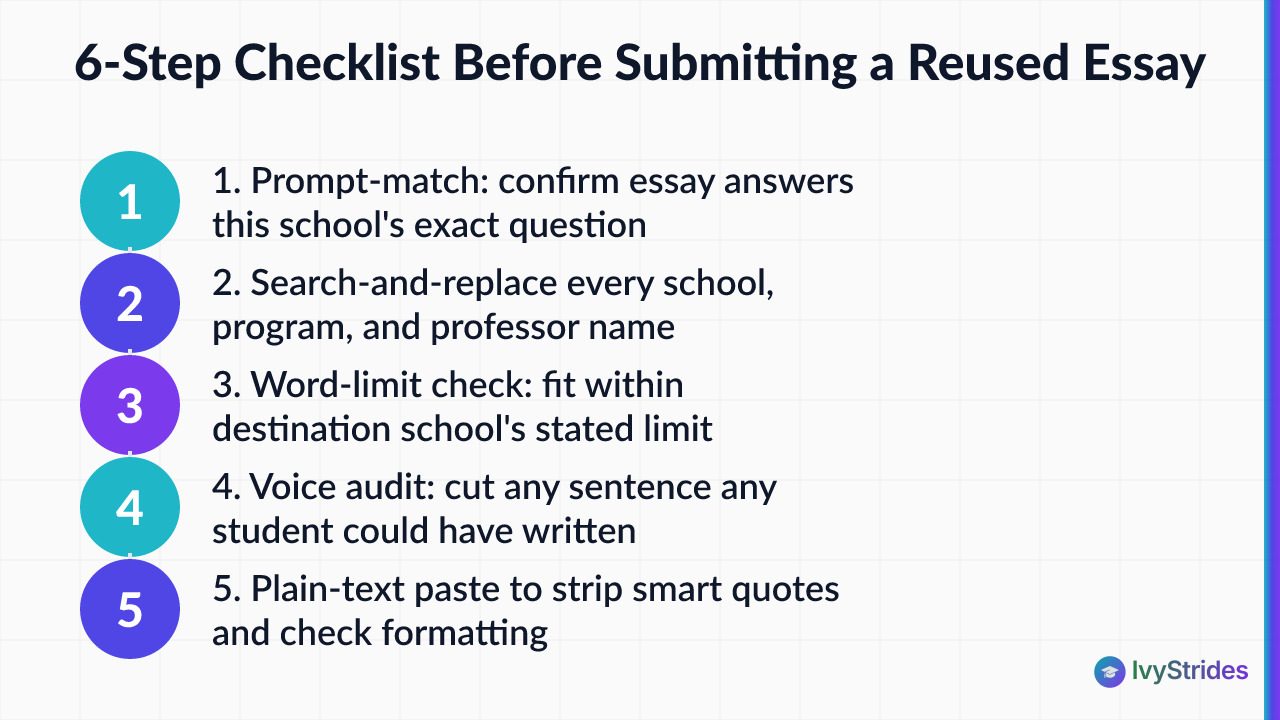
Run this checklist before you click Submit on any reused essay. Six steps. About ten minutes.
-
Prompt-match verification. Read the destination school's exact prompt aloud. Read your reused essay aloud. Does the essay answer this specific question, or a similar one? If it's similar-but-not-identical, you have edits to make.
-
Institution-name search-and-replace. Use Ctrl+F (or Cmd+F) to search for every school name, program name, professor name, and city name in the essay. Every single one. This is where the wrong-school error hides.
-
Word-limit compliance. Confirm your essay fits within the destination school's stated word or character limit. Common App enforces 650 on the personal statement, but supplementals vary widely, typically from 100 to 650 words, and going over gets truncated or flagged.
-
Voice and specificity audit. Read the essay aloud. Does it sound like you talking, or does it sound like a template? If any sentence could have been written by any student, cut it or rewrite it. Voice is what makes reuse work.
-
Plain-text paste formatting check. Paste the essay into a plain-text editor first to strip smart quotes and special characters. Then paste from there into Common App or the destination portal. Scroll through the submitted version to confirm nothing got corrupted.
-
Fresh-eyes review. Have a second reader (parent, counselor, coach) check for any school-specific references that don't match the destination school. This is the last defense against the institution-name error, and it catches things you cannot see because you wrote it.
Our essay review service runs this exact checklist against every essay we review, plus a substantive read for voice and prompt-fit.
FAQ
Can you reuse college application essays across different schools?
Yes, with conditions. Your Common App personal statement is submitted identically to all Common App member schools by design. Supplemental essays require prompt-specific tailoring before reuse. The key test is whether the reused essay still directly answers the prompt at the destination school, and whether it contains any references to a different institution that need to be swapped out.
Can I change my Common App essay after I have already submitted to one school?
Yes, but only for schools you have not yet submitted to. Once you click Submit for a specific school, that school's copy of your essay is permanently locked. You can still edit the essay in your Common App account, and the updated version will go to the next school you submit to. Plan your submission order accordingly if you want to refine the essay mid-cycle.
Is it okay to copy and paste my essay directly into the Common App?
Technically yes, but paste into a plain-text editor first to strip smart quotes, curly punctuation, and special formatting characters that can corrupt in the Common App text field. After pasting into Common App, scroll through the full essay to check that no characters have been replaced with symbols or question marks. This takes about 90 seconds and prevents a real problem at submission.
Should I reuse supplemental essays for different colleges?
Only after a careful prompt-match audit. Activity essays and challenge essays with overlapping themes can be adapted with targeted edits, which is Tier 2 reuse. Why School and Why Major essays are almost always school-specific and belong in Tier 3, meaning you rewrite for each institution. In our coaching, submitting a Why School essay that references the wrong school's programs is one of the most damaging reuse errors we see in essay reviews.
Can I reuse my Common App essay when reapplying to a school in a later cycle?
Technically possible, but not advisable without significant revision. Admissions offices may retain records of prior applications, and submitting an identical essay signals that nothing has changed in your thinking or growth. If you're reapplying, update the essay to reflect what you have learned, done, or accomplished since the previous application. Reapplication essays that show real evolution read very differently than ones that don't.
Do colleges share essays with each other to catch reuse?
There's no documented cross-institutional essay-sharing system among US colleges. The worry that schools compare essays to catch reuse is largely a myth. The real risk is internal to a single application: submitting an essay that references the wrong school by name, or that answers a different school's prompt, which the destination school's admissions officer will notice on the first read.
Your Next Move
Reuse well and your application workflow shrinks by half. Reuse carelessly and one wrong school name can undo weeks of work. The three-tier framework tells you which essay is which. The six-step checklist tells you what to run before you submit. What's left is the anchor draft, the personal statement everything else adapts from, and whether it's strong enough to carry the weight.
If you want a second read on that anchor draft, meet the tutors who work with students at each stage of the essay process.

Award-winning author (South Asian Book Award) and graduate of BITS Pilani and UCLA Luskin School of Public Affairs. Brings a published writer's eye to Common App essays and grammatical precision to SAT and ACT R&W instruction.