
How to Write a Transfer Application Essay for 2026-27: A Step-by-Step Guide
On this page
- Do Transfer Students Need to Write an Essay, and What Does It Actually Cover?
- What to Include in a Transfer Essay: The Two Questions Every Reader Asks
- How to Structure a Transfer Essay That Admissions Readers Actually Finish
- How to Revise a Transfer Essay Without Losing Your Voice
- FAQ: Transfer Application Essays
- Do transfer students need to write an essay?
- How do you write a good transfer application essay?
- How do you write a Common App transfer essay?
- How do you write a successful transfer essay?
- Your Next Step on the Transfer Essay
A transfer application essay is the writing task where you answer two questions: why you need to leave your current college, and why the target school is the specific right fit. Keep the tone forward-looking, name concrete programs, and stay inside the personal essay range on the Common App transfer application: 1,250 to 3,250 characters, or about 250 to 650 words.
Those two questions sit at the center of the transfer file, where most of your college grades and coursework are already on the transcript. The essay is the part you can still shape. The rest of this guide shows you what to write for each question, how to structure the arc, and how to revise without flattening your own voice.
Do Transfer Students Need to Write an Essay, and What Does It Actually Cover?
Whether you write an essay, and which one, is each transfer program's decision: some ask for the Common App personal essay, and some set their own essay questions in addition to it or in place of it. Common App for transfer is a separate application, and you need a new transfer account because a first-year account cannot be used for it. Each program lists its writing requirements in its Program Materials section, so you check every target program there before you assume anything.
When a program asks for the personal essay, you select one of seven Common App prompts, unchanged for 2026-27, and write 1,250 to 3,250 characters, about 250 to 650 words. The seventh prompt lets you share an essay on any topic of your choice, which gives a transfer applicant room to build the whole essay around the why transfer and why this college questions.
Beyond the personal essay, some programs require an additional essay in their Program Questions section, with its length set by that program. More than 700 colleges accept Common App for transfer, and one college can offer several programs, each with its own requirements, so read every program's questions before you draft.
Hardship has its own field. If a specific circumstance drove your decision, the Challenges and circumstances question on the transfer application, capped at 1,250 characters, lets you give colleges that context so the personal essay can stay on academic fit. Each program sets its own deadline, so listing every target program's date before you draft is the first planning step for protecting your revision time.
| Component | Word or Character Limit | Required or Optional |
| Common App personal essay | 1,250 to 3,250 characters (about 250 to 650 words) | Each program decides |
| Supplemental transfer essay | Set by each program | Varies by program |
| Challenges and circumstances | 1,250 characters | Optional |
| Additional details | 1,500 characters | Optional |
Source: Common App and the Common App for transfer help center.
What to Include in a Transfer Essay: The Two Questions Every Reader Asks
A transfer essay has to answer two questions with evidence: why your current school cannot meet a concrete academic need, and why the target school can. Those two pillars, why transfer and why this college, carry almost the entire essay. Common App for transfer's own essay guidance asks the same things: your reasons for transferring and the new opportunities you hope to explore.
Watch that your why transfer section does not read as a list of complaints about the current school; it should be a forward-looking narrative about the target one. A reader who finishes a complaint learns what you dislike, not what you want. So reframe it. Instead of "my current school doesn't have a neuroscience track," write toward the need: the research question you want to pursue and the lab that can host it.
Program-level specificity answers the second question. Name a professor's research area or a specific course sequence; praise for a "collaborative environment" or a "strong alumni network" could describe any campus and tells the admissions reader nothing about your academic fit. The why this college section follows the same specificity rules as a first-year supplemental essay that shows genuine fit, but the stakes are higher because the transfer reader expects you to have done real research.
| Section | Core Question | What Weak Answers Look Like | What Strong Answers Include |
| Why transfer | Why leave your current school? | Complaints, vague dissatisfaction | A specific unmet academic or professional need |
| Why this college | Why this school specifically? | "Great reputation," "diverse community" | Named courses, faculty, programs, opportunities |
One timing note shapes when you write. Common App for transfer warns that some programs fill their classes before their posted deadline, even when they do not say they use rolling admissions, so do not plan the essay around the last possible day.
How to Structure a Transfer Essay That Admissions Readers Actually Finish
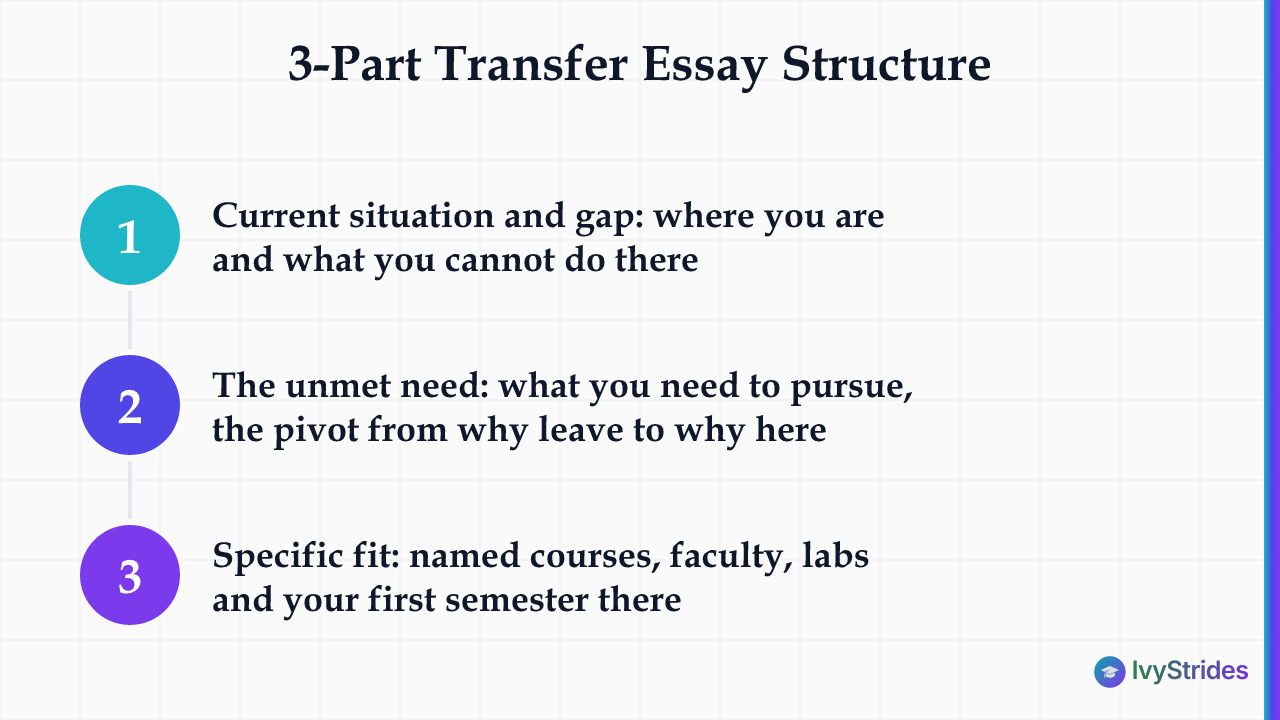
A transfer essay works best as a three-part arc: your current situation and the gap in it, the unmet need that gap creates, and the specific fit at your target school. That structure carries both pillars from the section above, the why transfer need and the why this college evidence, in an order a reader can follow without re-reading.
Open on a moment, not a complaint. The opening paragraph should drop the reader into a specific scene or decision at your current institution, not a grievance. A student who describes the afternoon she realized her college had no path to the computational linguistics work she wanted gives the reader something concrete; a student who opens with "my school has disappointed me" gives them a tone to distrust.
The three-part arc looks like this:
- Current situation and gap. Establish where you are and the specific thing you cannot do there. Roughly the first third of your essay.
Daily SAT and ACT prep on YouTube: short strategy videos from IvyStrides. Subscribe to IvyStrides on YouTube.
-
The unmet need. Name what you need to pursue and why it matters to your trajectory. The pivot from "why leave" to "why here" lives here.
-
Specific fit at the target school. Named courses, faculty, labs, or programs, and a concrete picture of what you'll do in your first semester. The closing third.
Before you draft, answer one question: what will you do in your first semester at the target school that you cannot do where you are now? That answer becomes the spine of the essay. The three-part arc borrows from the same logic as a first-year personal statement structure, but the opening establishes context at your current college rather than a formative childhood memory.
Close with momentum, not a summary. The final paragraph should look forward, not restate what came before. One practical point: Common App for transfer locks most sections once you submit, but you can still edit program materials for programs you have not yet submitted to, so a later program can get your sharper draft. You can submit until 11:59 PM in your local time zone on the deadline date, but leave time for the payment step that comes with submission.
How to Revise a Transfer Essay Without Losing Your Voice

Revision is where a transfer essay can lose the honest, specific voice that made the first draft worth reading. The three-part arc you just built survives revision only if you protect its two assets: the forward-looking tone and the program-level evidence. Over-editing usually sands both of those down into something smooth and generic.
Three mistakes recur. Writers cut the specific course names to "tighten," then the fit argument collapses into praise. They add polished fit language that sounds like a brochure. Or they edit the honest voice into something careful and flat. Watch for all three on every pass. The revision stage is exactly where editing a college essay can erase what makes it yours if you are not deliberate.
If the gap between your current draft and a compelling transfer essay feels wider than a few passes can close, IvyStrides offers one-on-one essay coaching in which you write every draft, a coach reads each one, and the voice stays yours.
Run this checklist before you call a draft done:
- The opening is a specific moment, not a complaint about your current school.
- The why transfer section names a concrete need, not a grievance.
- The why this college section names real courses, faculty, or programs.
- The specificity survived your last round of cuts.
- The tone reads forward-looking from first line to last.
- The essay is between 1,250 and 3,250 characters, about 250 to 650 words.
- The honest voice from the first draft is still audible.
The essay is one part of a transfer file, and each program weighs it alongside your coursework and other materials in its own way. When a draft still feels off after a few passes, the fix is often one of the common college essay mistakes that make a transfer file read generic, and naming which one tells you what to rewrite.
FAQ: Transfer Application Essays
Do transfer students need to write an essay?
It depends on the program. On Common App for transfer, some programs ask for the personal essay, and some set their own essay questions in addition to it or in place of it. Programs at the same college can differ, so check each target program's Program Materials section before you assume the essay is optional.
How do you write a good transfer application essay?
A good transfer essay answers two questions with specificity: why your current school cannot meet a concrete academic or professional need, and why the target school can. Avoid complaints about your current institution. Name specific programs, courses, or faculty at the target school to show you've done genuine research rather than reading a ranking.
How do you write a Common App transfer essay?
If the program asks for the personal essay, pick one of the seven Common App prompts, unchanged for 2026-27, and keep it between 1,250 and 3,250 characters, about 250 to 650 words. Use the essay to explain your transfer motivation and your fit with the target school. If a hardship drove your decision, the separate Challenges and circumstances question on the transfer application, capped at 1,250 characters, can carry that context.
How do you write a successful transfer essay?
A successful transfer essay is forward-looking, not complaint-driven. It opens with a specific moment or need, pivots to what the target school offers that your current school cannot, and closes with a concrete picture of what you'll do there. Specificity about programs and opportunities is what separates a memorable draft from a generic one.
Your Next Step on the Transfer Essay
You know the task now: two questions, a three-part arc, and a revision pass that protects your voice. The move that matters is starting the draft before the deadline gives you no room to revise.
- Open a blank document and write the three-part arc: current gap, unmet need, specific fit.
- List named courses, faculty, or programs at each target school before you write the fit section.
- Put hardship context in the Challenges and circumstances field so the essay can stay on fit.
- Revise against the checklist, then confirm each program's requirements in Common App for transfer.
College admissions insights on LinkedIn: follow IvyStrides for application guidance and counseling updates.

Hemant is a seasoned entrepreneur, investor, and growth strategist with deep ground in education and technology-driven learning. His core training is in Mathematics and Physics — he authored Physics for IB Diploma: Ultimate Revision Guide, recognized as a top student resource.