
Should You Switch From the SAT to the ACT? A Diagnostic-Based Way to Decide
On this page
- Three SAT Plateau Signals That Make Switching to the ACT Worth Evaluating
- How the ACT and Digital SAT Formats Differ in Ways That Affect Your Score
- How to Run the ACT Diagnostic That Settles the Switch Decision
- When Switching From SAT to ACT Makes Sense, and When It Does Not
- FAQ: Switching From the SAT to the ACT
- Why is act better than sat?
- How different is act from sat?
- Is act easier than sat reddit?
- Can you switch sat dates?
- Your Next Step on the Switch Decision
Switch only if your SAT score has stalled across several timed practice tests and a cold ACT diagnostic, converted with the official ACT/SAT concordance tables, lands at least as high. The SAT-to-ACT switch is a data decision, not a feeling about which test is easier. If your next test date is close, staying put is the lower-risk path.
Switching costs time you may not have. A midstream switch means a fresh diagnostic, a new format and a new prep timeline, so the question is never "which test do I like," it's "which test does my score data support before my deadline."

Three SAT Plateau Signals That Make Switching to the ACT Worth Evaluating

Photo by Andy Barbour on Pexels
A flat score is the first signal. If your total barely moves across several full-length practice tests taken timed and under real conditions, treat that pattern as a diagnostic signal, not a motivation problem. The first question is whether it shows a skill ceiling or a prep gap that targeted work could close, because the answer decides whether a switch is even worth considering.
Before you conclude the score is stuck, rule out the targeted-weakness fixes that can still move a flat score. That's the honest order of operations: break the plateau first, then ask about the ACT.
Score band is the second signal. A flat mid-range SAT total can hide a specific domain gap, such as Standard English Conventions or Algebra, and the performance bands by content domain on your score report point to it. A flat score near the top of the 400 to 1600 scale (College Board) is a different story, because the remaining points are the hardest ones on the test.
Timeline is the third signal. When your target test date is close, a plateau alone does not justify a switch, because learning a new format takes prep time. Put the real dates side by side: the ACT's winter dates are December 12, 2026 (late deadline November 29) and February 27, 2027 (regular deadline January 22, late deadline February 9), and the SAT's are December 5, 2026 (register by November 20) and March 6, 2027 (register by February 19).
| Signal | What it looks like | What it means |
| Flat score | Little movement across several timed tests | A possible ceiling; rule out prep gaps first |
| High band plateau | Flat near the top of the scale | Remaining points are the hardest to gain |
| Short runway | Target test date is close | Switching risk outweighs upside |
How the ACT and Digital SAT Formats Differ in Ways That Affect Your Score
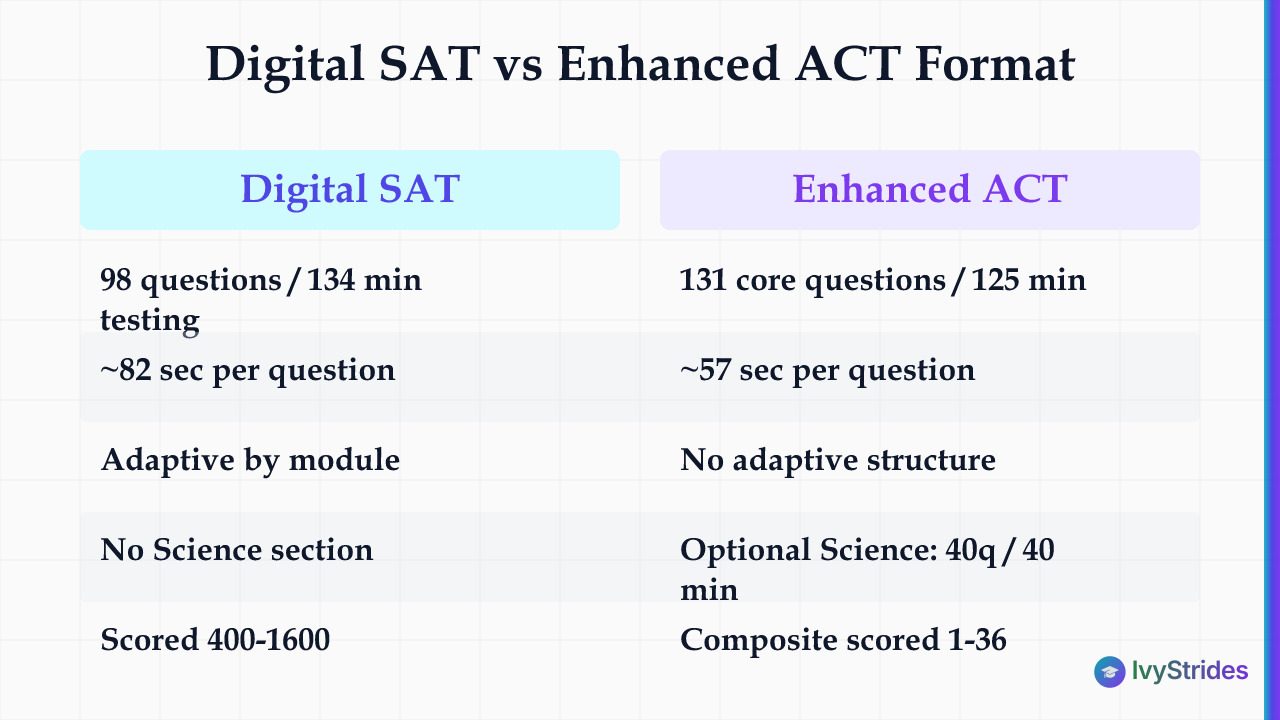
The Digital SAT and the enhanced ACT differ most in pacing, section structure, and whether the test adapts to you. Those three differences, not vague impressions of difficulty, decide which test fits your skill profile.
The Digital SAT runs 98 questions in 2 hours 14 minutes of testing, split into Reading and Writing (54 questions in 64 minutes) and Math (44 questions in 70 minutes), each split into two modules, the second adapting to how you did on the first (College Board). The enhanced ACT core runs 131 questions in 125 minutes across English, Math, and Reading, with no adaptive structure (ACT). It launched online in April 2025 and on paper in September 2025, so compare it against the enhanced ACT format and what changed, not against guides written for the longer legacy test.
Pacing is the sharpest split. IvyStrides' analysis of the two official formats puts the gap in seconds: College Board's 134 minutes of SAT testing across 98 questions works out to about 82 seconds per question (about 71 in Reading and Writing and 95 in Math), while ACT's 125 minutes across 131 core questions works out to about 57 seconds. If you read fast and decide quickly, the ACT's tighter clock can favor you. If you need time to think, the SAT's longer per-question window is friendlier.
Science is an ACT-only section. The optional ACT Science section runs 40 questions in 40 minutes and does not affect your Composite score (ACT). The Digital SAT has no Science section. ACT English tests many of the same rhetorical and transition skills you already drilled on the SAT, but under tighter per-question time, so your work on transition questions in both tests gives a switching student a head start.
Composite and superscore work differently. The ACT Composite is the average of English, Math, and Reading only; Science and Writing stay out of it. The ACT Superscore Composite now uses your best English, Math, and Reading scores across attempts; before 2025 it could include all four sections. Not every college superscores the ACT (ACT), and on the SAT, whether to superscore is each college's decision.
Get your Daily IV Dose on Instagram: quick study tips and test-day advice for high school students. Follow @ivy.strides.
| Feature | Digital SAT | Enhanced ACT |
| Questions | 98 | 131 (core) |
| Testing time | 2 hr 14 min | 125 min (core) |
| Per-question pace | about 82 sec (71 R&W, 95 Math) | about 57 sec |
| Adaptive? | Yes, by module | No |
| Science section | None | Optional, 40q/40min |
| Scored on | 400 to 1600 | Composite 1 to 36 |
| Superscore | Each college decides | Best English, Math, Reading; each college decides |
How to Run the ACT Diagnostic That Settles the Switch Decision
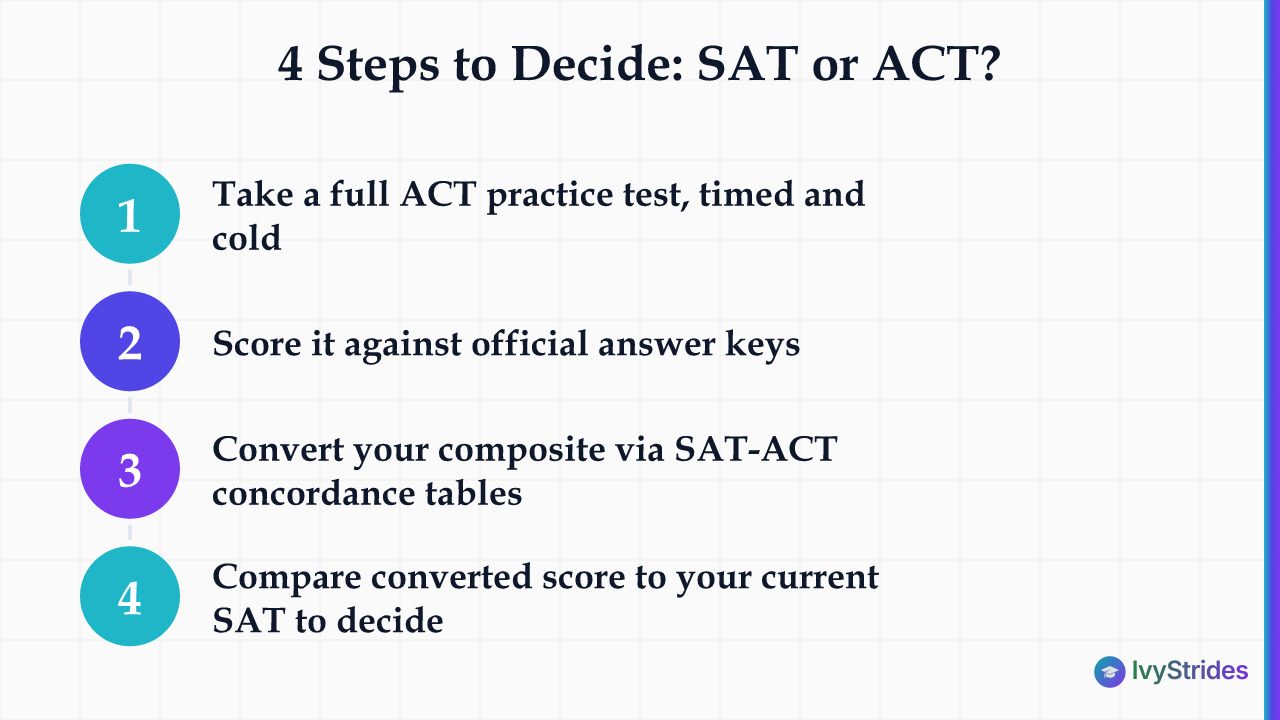
The redo diagnostic is one full-length, timed ACT practice test taken cold, under real conditions, before you register for anything. That single session, converted to an SAT-equivalent score, tells you more about test fit than any amount of informal comparison, because a gut feeling about which test is easier is not evidence of which test produces your higher score.
Use a reliable test. The cold diagnostic needs a full-length test written to the enhanced format to produce a comparable score, so choose from ACT practice tests that match the real exam rather than a random online quiz. Time each section as ACT does: English 35 minutes, Math 50, Reading 40.
Convert, then compare. Before registering for the ACT, convert your cold diagnostic Composite to an SAT-equivalent score with the SAT to ACT score concordance tables that ACT and College Board released in 2018, before the enhanced ACT, then compare it to your current SAT. ACT states that these tables compare scores but do not predict performance on the other test (ACT), so read the result as a direction: a converted score at or above your current SAT supports a switch, and one clearly below it says stay on the SAT.
If the diagnostic supports a switch, count the weeks to your ACT date and build the plan backward from it, with section work first and full timed tests near the end. A compressed plan like ACT prep in two months gives every week a job, which is what a short runway demands.
| Step | Action | What you learn |
| 1 | Take a full ACT test, timed, cold | Your true starting point |
| 2 | Score it against official keys | A real composite, not a guess |
| 3 | Convert via concordance | Your ACT score in SAT terms |
| 4 | Compare to current SAT | Switch, wait, or stay |
When Switching From SAT to ACT Makes Sense, and When It Does Not
Switching makes sense when four conditions all hold: your plateau shows up across several timed SAT tests, your cold diagnostic converts at or above your current SAT score, your deadline leaves room to learn a new format, and the ACT's faster pace suits you. Miss any one and the midstream switch costs more than it returns.
When to stay put. If your cold diagnostic converts clearly below your SAT, the data does not point to the ACT as your stronger test, and switching throws away real prep. If you haven't confirmed a plateau, the fix is targeted SAT work, not a new test. And with a short runway, staying on the SAT is the safer call.
The test-optional caveat still applies. Policies vary by school and year, so confirm on each target college's own admissions page whether it uses scores at all. If they do, the switch is only worth it if the ACT path reaches the ACT score your target colleges expect.
Once you confirm a switch, build the plan around your specific ACT section gaps, not a generic course. IvyStrides' one-on-one ACT prep starts from that point: a diagnostic and a custom ACT roadmap, an expert instructor, and a flexible schedule of usually 12 to 16 weeks, with section emphasis set by the diagnostic. If you'd rather stay the course on the SAT after all this, revisit how to study for the SAT and double down.
| Condition | Switch to ACT | Stay on SAT |
| Plateau confirmed | Yes | Not confirmed |
| Cold diagnostic, concorded | At or above your SAT | Clearly below your SAT |
| Time to deadline | Room to learn a new format | Too short to relearn |
| Pacing fit | Fast reader | Needs more time |
FAQ: Switching From the SAT to the ACT
Why is act better than sat?
Neither test is objectively better. The ACT's non-adaptive format and faster core pacing, about 57 seconds per question, suit students who read quickly and work well under time pressure. The Digital SAT's adaptive modules and longer per-question time, about 82 seconds, suit students who prefer depth over speed. A cold diagnostic on each test shows your fit far better than any ranking.
How different is act from sat?
The enhanced ACT core runs 131 questions in 125 minutes with no adaptive structure; the Digital SAT runs 98 questions in 2 hours 14 minutes with adaptive modules. The ACT adds an optional Science section; the SAT does not. The ACT reports a 1 to 36 Composite from English, Math, and Reading, while the SAT total runs 400 to 1600.
Is act easier than sat reddit?
Forum opinion is mixed because difficulty depends on the student. If the SAT's adaptive second module rattles you, the ACT's single fixed form may feel steadier; if you need more time per question, the ACT's clock may feel harder. A cold, timed diagnostic on each test tells you more about your higher score than any thread.
Can you switch sat dates?
Not directly. To change the test date, College Board says you must cancel and register for a new test (College Board). Canceling before the change deadline costs $34; after it, through the Thursday before test day, the fee is $44 (College Board). That is separate from switching between the SAT and ACT entirely.
Your Next Step on the Switch Decision
Your own data answers the switch question, in a specific order. Don't register for anything until you've run that order.
- Confirm a plateau across several timed SAT tests.
- Take one full ACT practice test, timed and cold.
- Convert it with the ACT/SAT concordance tables and compare to your SAT.
- Count your weeks: a short runway means stay on the SAT.
- If all four switch conditions hold, build an ACT plan around your section gaps.
Watch the method, then try it: IvyStrides explains SAT and ACT question types on YouTube.

Rajesh is a technology leader, entrepreneur, and angel investor with 28+ years in Business & Technology Leadership and Product & Solution Engineering. He is passionate about education, mentoring, and driving digital transformation.