
In UT Austin's Supplemental Essays, a Job Can Be Your Proudest Activity
On this page
- What Does UT Austin Actually Require in Writing for 2026-27?
- How to Write the UT Austin Why Major Short Answer
- Why a Job or Family Responsibility Is a Valid Proud Activity at UT Austin
- Optional Pieces: Resume, Letters, and the Third Short Answer
- FAQ: UT Austin Supplemental Essays
- Does UT Austin have any supplemental essays?
- What are the prompts for the UT Austin supplemental essays for 2026-27?
- Does UT Austin require the SAT or ACT for 2026-27?
- Is a 1400 SAT good for UT Austin?
- Your Next Step on the UT Austin Essays
UT Austin supplemental essays are the required writing components of the 2026-27 freshman application: one main essay (500-650 words, any topic) and two short answers of about 250-300 words each. Short Answer 1 asks why you chose your first-choice major. Short Answer 2 asks which activity you are most proud of, and a job counts.
Those prompts and limits come from UT Austin's official Essays and Short Answers page. The detail that trips students up sits in Short Answer 2: UT names a job and a family responsibility as valid activities, in its own words, so you don't need a club-leadership story to answer it honestly.
What Does UT Austin Actually Require in Writing for 2026-27?
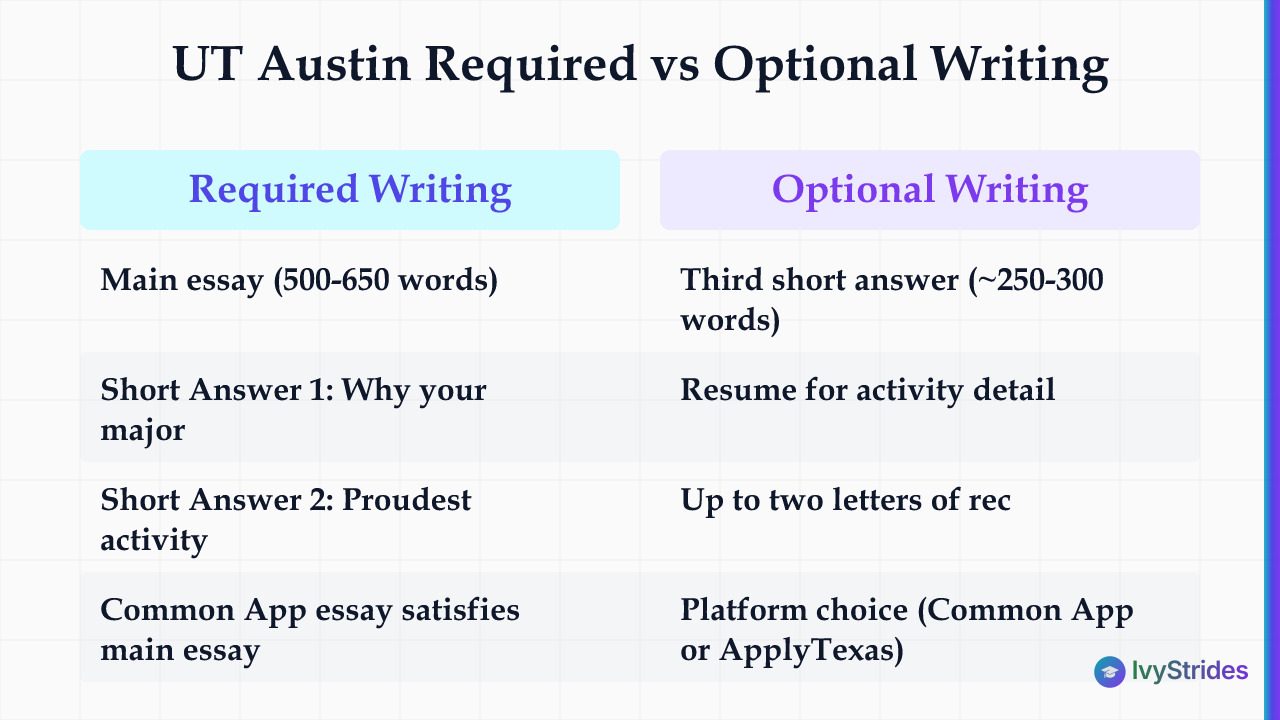
UT Austin requires one main essay of 500-650 words plus two short answers capped at about 250-300 words or 40 lines each, per the Essays and Short Answers page. Your Common App personal statement satisfies the main essay requirement, so you do not write a separate 650-word essay for UT; the energy you save goes into the two short answers. UT will not review your other Common App essays.
The two required short answers. Short Answer 1 asks why you are interested in your first-choice major. Short Answer 2 asks which activity, in or outside school, you are most proud of and why. There is also one optional third short answer.
Summer and fall applicants can apply through either the Common App or ApplyTexas. UT encourages the Common App but says the platform you pick will not affect the decision, per its admissions FAQ. Unlike schools that ask five or more supplemental prompts, UT limits required writing to two short answers plus the main essay, which leaves room to adapt the Proud Activity answer for other schools' activity or community prompts.
| Component | Required? | Word / Line Limit | Prompt Summary | Deadline |
| Main essay | Yes | 500-650 words | Any topic; Common App essay satisfies it | EA Oct 22 / Regular Dec 10 |
| Short Answer 1 | Yes | ~250-300 words / 40 lines | Why your first-choice major | EA Oct 22 / Regular Dec 10 |
| Short Answer 2 | Yes | ~250-300 words / 40 lines | Activity you are most proud of | EA Oct 22 / Regular Dec 10 |
| Third short answer | Optional | ~250-300 words / 40 lines | Added context | With application |
| Resume, letters | Optional | See below | Activity detail; up to two letters | With application |
Early Action closes October 15 with materials due October 22; a decision or deferral arrives by January 15, 2027. Regular closes December 1 with materials due December 10. Mapping UT's two short answers against how many supplementals most students write across a full college list tells you where this file sits in your term.
How to Write the UT Austin Why Major Short Answer
The UT Austin Why Major short answer asks why you are interested in your first-choice major, in about 250-300 words. Because UT's holistic review weighs the competitiveness of your chosen major alongside your essays, this short answer carries more weight than it does at schools where major selection happens after admission, per the Review and Decision Process page.
If you qualify for automatic admission, UT still reviews your file to decide your major, so the Why Major short answer matters even for top-ranked Texas applicants. The General Information Catalog states that auto-admit files are reviewed only to decide the major. Some majors look only at first-choice applicants, and the calculus-readiness gate applies to all Cockrell Engineering majors, all Jackson Geosciences majors, both Environmental Science majors, and Computer Science and its combined CS majors.
Name something only UT has. A common pattern in Why Major drafts is a first paragraph describing a general interest in the field with no mention of UT specifically. The second draft improves when the student names one program, lab, or faculty area at UT that connects to that interest. UT also tells students to pick a major aligned with their interests and strengths, not just a hoped-for career, per the admissions FAQ.
Why Major Short Answer: What to Include in 250-300 Words
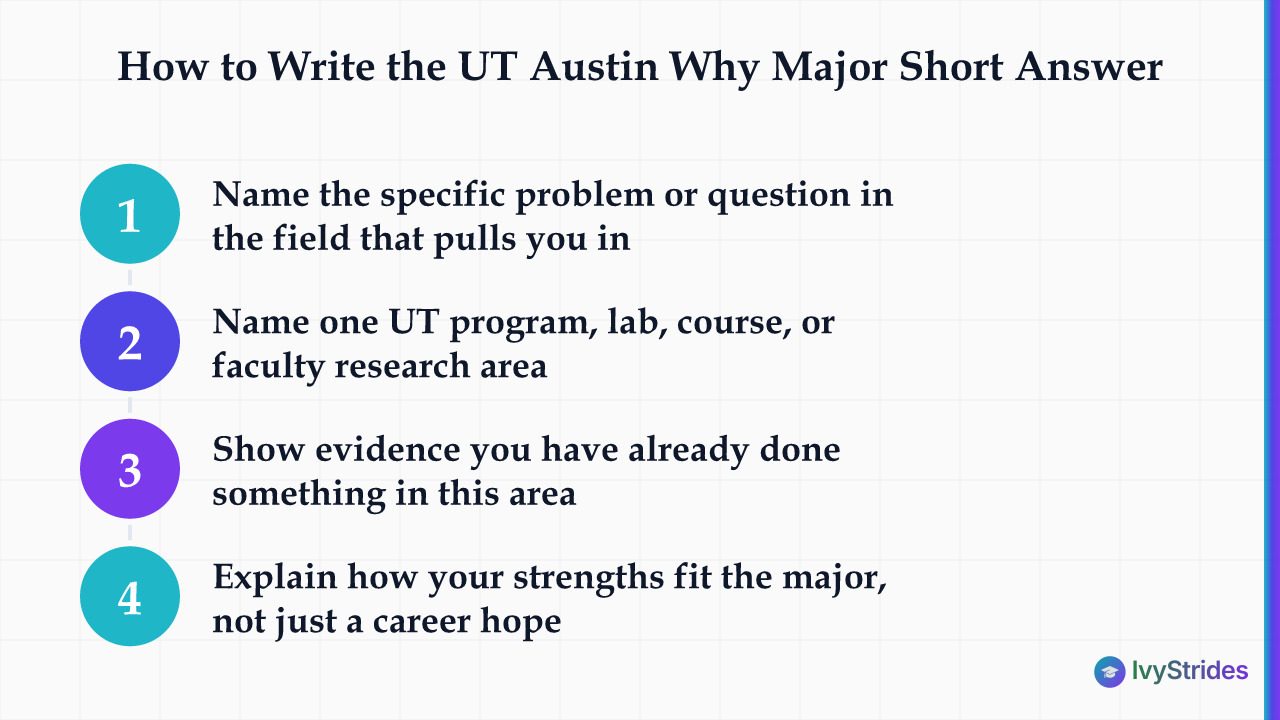
- The specific problem or question in the field that pulls you in
- One named UT program, lab, course, or faculty research area
- Evidence you have already done something in this area
- How your strengths, not just your career hope, fit the major
- A second-choice major only if the prompt asks
- Plain language, no padding to hit the word limit
A step-by-step structure for how to answer the Why This Major essay keeps these elements in order. The class-rank threshold behind UT Austin auto-admit and major placement explains why the major review still runs for admitted students.
Why a Job or Family Responsibility Is a Valid Proud Activity at UT Austin
The UT Austin Proud Activity short answer asks which activity, in or outside school, you are most proud of and why, in about 250-300 words. UT's own prompt lists the valid choices in plain words: a club, volunteering, a job, or a family responsibility, per the Essays and Short Answers page. So if you work 20 hours a week to help your family, that is not a gap in your record. That is your answer.
Why UT reads it that way. The Review and Decision Process page names "special accomplishments plus work and service in and out of school" as a holistic review factor. The 2026-27 catalog goes further, naming special circumstances the file reader weighs: socioeconomic status, growing up in a single-parent home, family responsibilities, and overcoming adversity.
Students writing about a job or family responsibility often find the details already concrete in their minds, the hours per week, the exact tasks. A short answer is 250-300 words. You cannot fake specificity in that space, and you don't need to.
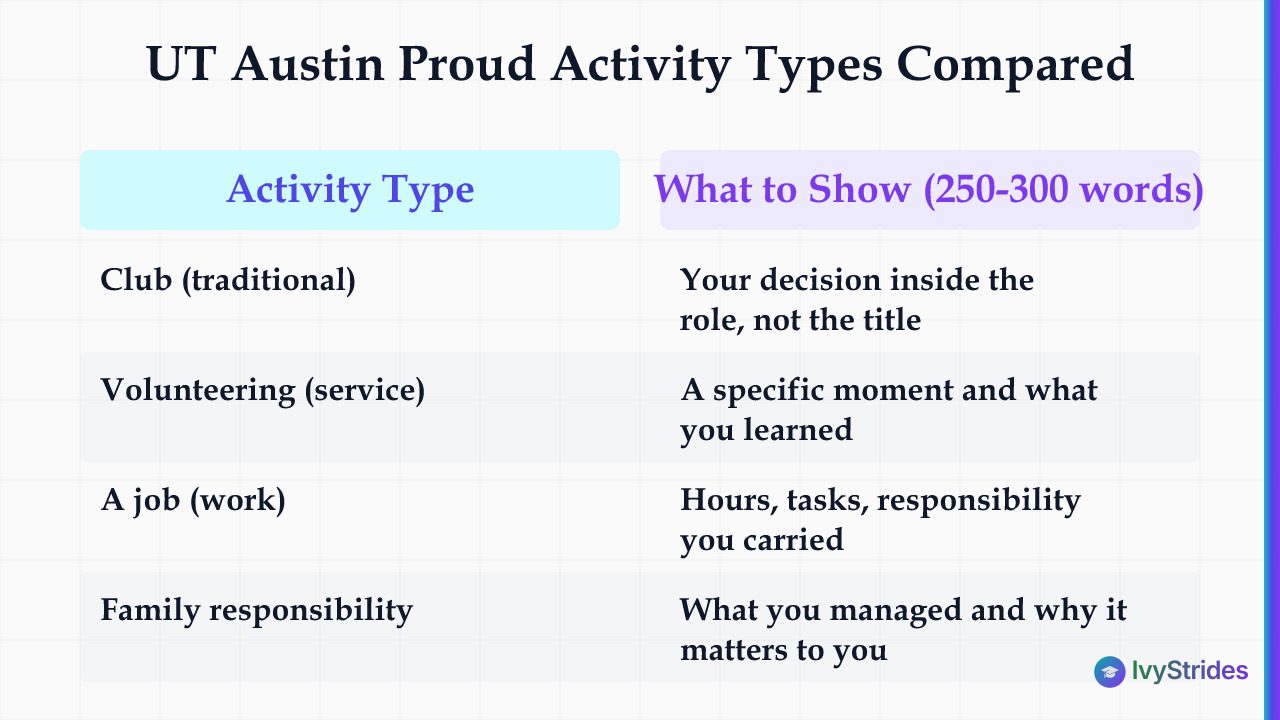
| Activity type | UT's own example | What to show in 250-300 words |
| Traditional | A club | Your decision inside the role, not the title |
| Service | Volunteering | A specific moment and what you learned |
| Work | A job | Hours, tasks, responsibility you carried |
| Family | A family responsibility | What you managed and why it matters to you |
The Proud Activity answer differs from the Common App activities list, which is a short descriptor; here you have room to show one activity in depth. The optional resume is where hours per week and weeks per year belong. Framing any activity as a compelling essay subject, traditional or not, is the same work whether the activity is a club or a shift schedule.
Optional Pieces: Resume, Letters, and the Third Short Answer
UT Austin's optional components for freshmen are a resume, up to two letters of recommendation, and a third short answer. Those optional pieces, done well, give the file reader the hours-per-week detail your Proud Activity answer could not fit. Format and length of the resume have no effect on review, per the admissions FAQ; UT wants the details of what each activity involved, hours per week, and weeks per year, and family responsibilities belong here too.
Letters: up to two, never from family. UT encourages writers from outside your high school and wants letters to show academic success and potential, leadership, persistence through challenges, interaction with peers from different cultural backgrounds, and preparation for your first-choice major.
| Component | Submit if... | Skip if... | Honors exception |
| Resume | You have activity detail beyond the list | Everything is already shown | Some honors programs require one |
| Letters | A non-family writer adds something new | No writer adds beyond your file | BHP, CSB, ECB want a teacher |
| Third short answer | You have real context to add | It would just repeat the file | None |
Honors program letter rules differ by program, per the freshman application page: Canfield BHP, Texas CSB, and Texas ECB want a teacher letter, while Turing and CNS Honors want a math or science teacher. Verify these directly with the program, since requirements shift year to year. Choosing recommenders who can speak to something your file does not already show is the decision that makes an optional letter worth submitting. When the full file still feels uncertain, our admissions essay coaching reviews each piece against UT's factors.
FAQ: UT Austin Supplemental Essays
Does UT Austin have any supplemental essays?
Yes. UT Austin requires two short answers of about 250-300 words each in addition to the main 500-650 word essay. The main essay is satisfied by your Common App personal statement. The two required short answers ask why you chose your first-choice major and which activity you are most proud of.
What are the prompts for the UT Austin supplemental essays for 2026-27?
For the 2026-27 cycle (entry fall 2027), the main essay is open topic, 500-650 words. The first required short answer covers why you want your first-choice major, and the second covers the activity, in or outside school, that you are most proud of, with UT listing a club, volunteering, a job, or a family responsibility as valid choices. Each short answer is capped at about 250-300 words or 40 lines.
Does UT Austin require the SAT or ACT for 2026-27?
Yes. UT Austin is test-required for the 2026-27 cycle (entry fall 2027). Applicants must send at least one official SAT or ACT score, or an official Classic Learning Test score, directly from the testing agency. The SAT school code is 6882 and the ACT code is 4240, and an official Classic Learning Test score is also accepted. Official scores are due October 22 for Early Action and December 10 for the Regular deadline.
Is a 1400 SAT good for UT Austin?
A 1400 SAT places a student at about the 93rd percentile nationally. Whether it is competitive at UT Austin depends on the chosen major, since some programs are far more selective than the overall pool. UT's holistic review weighs the competitiveness of the major alongside test scores, so the major choice matters as much as the score.
Your Next Step on the UT Austin Essays
You now have every writing requirement UT Austin publishes for 2026-27: the main essay, the two required short answers, and the optional pieces. Admissions outcomes depend on the full application, not the essays alone, and the strongest short answers are the honest ones.
- Draft the Proud Activity short answer around the activity you are genuinely most proud of, job or family responsibility included.
- Draft the Why Major short answer with at least one specific UT program, lab, or faculty area named.
- Decide on the optional resume and letters based on whether each adds something your file does not already show.
- Confirm honors program letter rules directly with the program before the October 22 or December 10 deadline.

Award-winning author (South Asian Book Award) and graduate of BITS Pilani and UCLA Luskin School of Public Affairs. Brings a published writer's eye to Common App essays and grammatical precision to SAT and ACT R&W instruction.